Andreas Paepcke

Table of Contents
- Features
- Packaging types
- Hearing aid distribution
- The model selection A/B test
- The provenance obfuscation game
- Hearing aid accessories
- The dark side
- The Web purchasing path
- Resources
- Test driving it all

The following pulls into one place all the research and experiences gathered while choosing a hearing aid. My focus was Philips, Oticon, and Phonak. Included in this post are the procedure of choosing, searching for a reasonable price, evaluating providers, and some first impressions. The resources section includes pointers to the Web where I found useful advice.
Many hearing aid overviews and marketing materials are available on the Web. This post is for persons who need details. This target audience makes the post dense to read in some places, but not all. Use the table of contents to navigate. Clicking section headings returns to the table of contents.

NOTE: when taking off your mask, the rubber bands may flick your hearing aids flying…Far!
The hearing aid market is flooded with brands, pricing tends to be astronomical, some business practices are arguably nefarious.
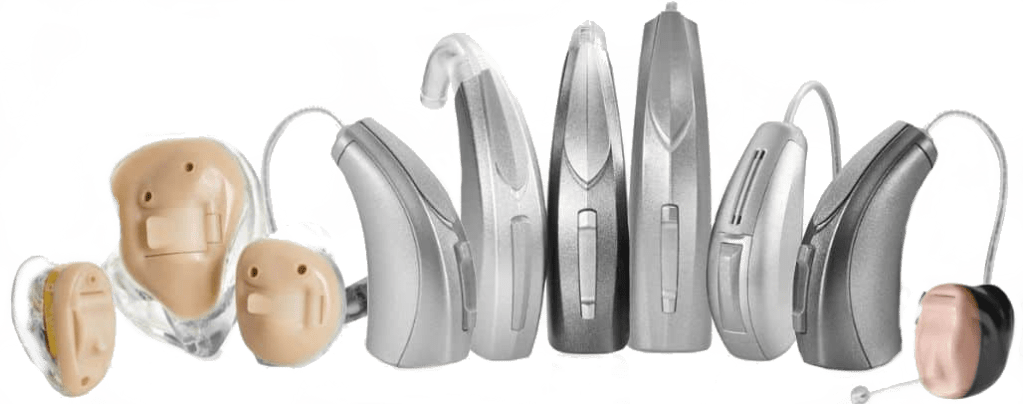
Much information must be gleaned from forum posts, and how-to videos. With dedicated research, however, progress can be had.
Features
Most of the modern hearing aids (HAs) are Bluetooth capable, pairing with cell phones, and sound streaming services. Some require a clip-on mike for hands-off phone operation, others use the HA microphones as the input to the cell phone during conversations.
Some models include a telecoil (T-coil) that links to hearing support in theaters, some lecture halls, and other public venues
Each brand has its own marketing terms for their sound processing and other procedures. There is OpenSound, a BrainHearing philosophy, SmartCharger, TwinLink, Deep Neural Networks, SmartSpeech, SerenityChoice, PureSound, ZeroDelay, and SoundProtect. Each is revolutionary(!), and details are vague.
Most hearing aids have microphones pointing to the front and back. All attempt to separate voice from background. Some say they intentionally include noise from the rear microphone in the mix they send into the ear canal. The ideas is to provide an open soundscape. Others attempt to find sources of spoken words, and direct a narrow cone of attention in that direction.
I heard from multiple professionals that all the major brands are excellent, but that individual differences do have patients prefer one over the other. You should expect a 3-year warranty, and 45 day return policy.
Many brands offer scandalously priced, but potentially highly desirable accessories. More on that later.
Packaging Types

Deciding between the shape of the HA housing is a tradeoff between degree of visibility, battery options, and room for technology goodies.
Someone with normal, age related hearing loss can decide relatively quickly on the desired hearing aid packaging. For more severe hearing loss, cochlear implants are an option. Major packaging options are:
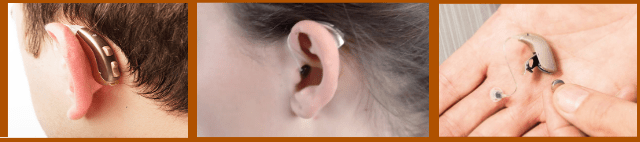
Behind-The-Ear (BTE) aid housings sit behind the ear, with a short, transparent, plastic ‘hose’ reaching a small ways into the ear. The housing contains the battery and electronics.
Receiver-In-Canal (RIC) aids are also worn behind the ear, but a longer plastic hose reaches down into the ear. At the end of the hose is the speaker, which in HA jargon is called a ‘receiver’
In-The-Ear (ITE) place the housing into the shell of the ear. They cover the ear canal, and are plainly visible from the side.
In-The-Canal (ITC) are smaller than ITE, and live inside the ear canal.
Completely-In-Canal (CIC) are smaller still, and are placed deeper in the canal.
Behind the ear models are larger than other technologies, and can therefore house more technology, and longer battery life. They are available in rechargeable and disposable battery versions. Rechargeables last around 12-14 hrs; batteries around a week.
In-canal models are not visible from the outside, but often only available with batteries, and their size makes them finicky to handle.
The rest of this overview focuses on BTE, and particularly RIC models.
The first big decision is: hearing clinic vs. Costco vs. over-the-counter (OTC)/Web.
Hearing Aid Distribution
Costco offers a free hearing test, and around three brands of hearing aids. My local store carried Jabra, Rexton, and Philips. All between $1600 and $1700, which is very reasonable. The formerly available Costco Kirkland white label hearing aid has been discontinued. Its manufacturer is rumored to have been the Swiss Sonova holding company, which also produces Phonak, and which owns the famous Senheiser audio company.
Costco does not carry the two top brands, Oticon, and Phonak. Both of these brands produce a series of HA families, which correspond to generations over the years. For example, most recent first.
- Oticon Real
- Oticon More
- Oticon XCeed
- Oticon Marval
- …
Or for the Phonak family:
- Phonak Audéo Lumity
- Phonak Audéo Paradise
- Phonak Audéo Marvel
- Phonak Naida
However, don’t be fooled by this simplicity. Each model comes in three or four ‘technology levels’. From what I can tell, the hardware in all tech levels of one model is identical. Software prevents the use of increasingly more features as the tech level decreases. For Oticon the levels are 1 to 4, for Phonak they range from 80 to 30. For example, there are Phonak Lumity levels 90, 70, 50, and 30, with 90 being the most feature rich. For each brand these tech levels are intentional technology choke points, though at decreasing prices.
Suppressed features include degrees of noise cancellation, and the number of parameters one can customize.
Apart from Costco, you buy HAs from specialized hearing clinics or, … from the Web. The latter is possible thanks to a 2022 FDA ruling that made hearing aids available ‘over the counter’ (OTC) without having to acquire through a clinic with the associated markup.
The Costco practitioner was ‘licensed hearing aid dispenser,’ trained by reading about the material at home, on the job training, and certified by an exam. This person clearly knew how to administer the hearing test, and competently explained the resulting chart.
The test consisted of me identifying with a button push when tones of varying frequencies were audible in a headset. Their loudness was increased from inaudible until I acknowledged their presence.

The test further included comprehension, where I was asked to repeat sentences feed at a for me comfortable volume. And finally a bone transmission test verified that the bone conduit reached my hearing apparatus.
These tests were administered in a sound booth, which I shared with the person administering the test. I was asked to look away, so that I could not see his choices of sound production. Duration of the encounter was 45 minutes.
I then repeated the evaluation in a hearing clinic. The practitioner was a doctor of Audiology from UCLA. They first checked for ear wax, which the Costco practitioner had done as well. However an audiologist is also allowed to remove the substance so that it would not interfere with subsequent tests by shifting on the ear drum.
The basic audio and bone transmission tests were identical to the one done at Costco. However, an additional test measured the ear drum’s response to pressure waves, and thereby whether the area behind the drum was free or congested.
At the clinic, I alone occupied the sound booth for the tests. The practitioner remained outside to control the machinery.
The Model Selection A/B Test
I returned to the clinic for a detailed comparison of the top tech level Oticon and Phonak products. I unfortunately did not take this step at Costco. I can therefore not speak to how such a test would unfold there.
This test was based on restaurant noise simulations in the sound booth.
It was concluded that an Oticon or Phonak device were appropriate. The clinic did not carry the Costco models. Pricing for the Phonak tech levels at the clinic were:
- L90: $8140
- L70: $7030
- L50: $5380
- L30: $4380
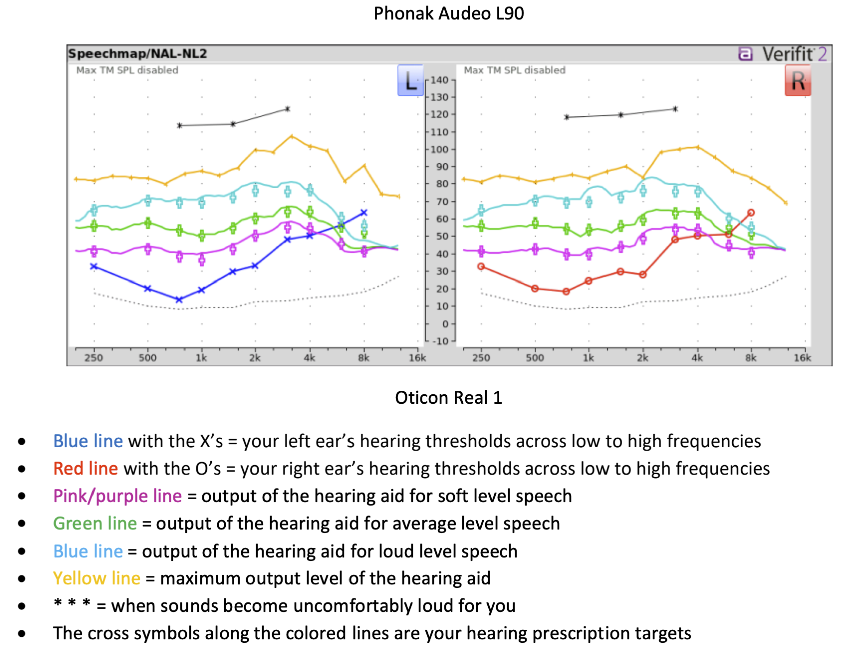
The experiment design was a single-blind A/B test under varying soundscapes. Before entering the booth, the practitioner performed a so-called Real Ear Measurement (REM).
The procedure tunes the hearing aids’ equalizer to compensate for each ear’s hearing condition at different frequencies and sound levels. The test is called a Real Ear Measurement (REM), or Real Ear Verification. It needs to be performed as part of fitting a purchased device.
This adjustment is performed separately for each each ear’s device, and is based on the patient’s prescription. The purpose is, given the prescription, to flatten the ear’s frequency response. The measurements are taken of sounds generated within the ear canal. It has been observed that this test is important, and not always performed. The result is a chart like this:
The in-booth test had me identify male- and female-voiced sentences over a simulated cocktail party soundscape.
Initially, the unaided ear was compared to Oticon at 0Db signal to noise ratio (SNR). Unaided I recognized 36% of the sentences. Oticon raised this measure to 48%. However, the experience required so much concentration that I would likely grab some pocket fulls of hors d’oeuvres, and leave the party.
Therefore the experiment was repeated for unaided, Oticon, and Phonak with the voices at 5Db above the noise level. All sentences were standardized.
The outcome for me was that unaided I performed at the 86% level. Oticon surprisingly lowered the performance to 77%, while Phonak raise performance to 90%.
This outcome was disappointing, in that I had hoped for a more significant boost, and less strain with one of the devices. It is unclear whether the differences are statistically significant.
The Provenance Obfuscation Game
Many of the brands are subsidiaries of a holding company. Two of those are Sonova, and Demant. In particular, Demant manufactures Oticon, Bernafon, Sonic, and Philips. Sonova is parent to Phonak, Unitron, Hansaton and Advanced Bionics.
Many sibling brands seem to use similar, or the same platforms. Others are sold under white labels at lower prices. But it seems impossible to dig up enough detail that one could safely purchase cheaply a device that is identical to a more expensive one.
Hearing Aid Accessories
Additional opportunities to spend money arise from accessories, particularly ones that address noisy soundscapes. Another noteworthy accessory device connects televisions to one’s hearing aid. The advantage of the TV connector is that the wearer can set their own volume, while non-impaired co-watchers can set volume to their comfort.
Accessories connect to a hearing aid either via Bluetooth (~10m/30ft), or via 2.5GHz radio (~15m/50ft). One has to embark on time consuming digs into the Web to find details of terms such as ‘AirStream Technology,’ and ‘ClearVoice.’ (All ‘clinically proven’, of course…) But the information is available.

Phonak devices aimed at noisy environments include a PartnerMic, which can be clipped on a one-on-one conversation partner’s lapel. An entire family of microphones for noisy environments is the Roger series . It includes the Table Mic II, which is a collection of circularly placed microphones contained in a disk shaped container that is placed on a table. The device detects voices, and activates the optimal microphone for transmission to the HA wearer.
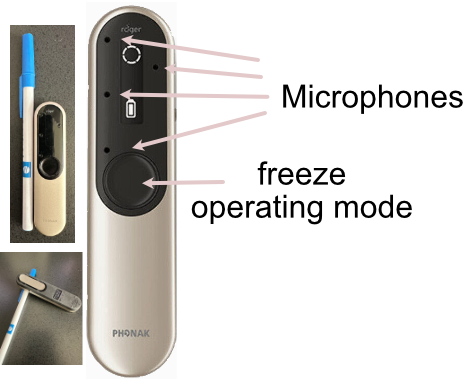
Noteworthy is the Roger ON handheld device. It contains four microphones, and an accelerometer. The accelerometer is used to place the device in one of several operating modes: if placed on a level surface, it picks up prominent voices, like the Table Mic. This directionality can be manually controlled via a smartphone app, or via the large operating mode button on the device.
Holding the device upward at an angle enters a Pointing Mode, a directional microphone intended to point at a conversation partner’s mouth. When hung from a presenter’s neck in a vertical position, the presenter’s voice is monitored and transmitted. The device’s charging station can be plugged into a television’s audio output for streaming to the hearing aid.
This marvel can be yours for as much as $2000, or maybe $1000, or $750? Let’s examine this range.

Another ‘accessory’ is the dome, which is a rubber half globe that is part of the receiver in the ear. The domes may be open, or closed.
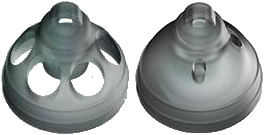
An open dome admits more of the surrounding sound into the ear canal. A closed dome mostly only admits the sound that was captured by the microphones, and processed for clarity and noise cancellation. These parts are inexpensive, and one can experiment.
The Dark Side
The above described Phonak device comes in two flavors: Roger On, and Roger On iN. Both eventually pair (via radio link) to your HAs. The Roger On iN additionally contains two ‘receivers.’ The term is highly inappropriate in that it conflicts with the HA portions that are slid into the ear canal. The term also implies a capability that is absent from your HAs. Like a firmware upgrade.
You need to transfer one of these ‘receivers’ to each of your two HAs by coaxing the Roger into the right mode, then placing them side by side. After this operation, the Roger On iN is ’empty.’ What is actually being transferred is not any receiver hardware, nor a firmware upgrade. It’s a license that is transferred. One to each HA.
What does this procedure imply? If I lose my HAs, or they break, or I get tired of them, I cannot sell my Roger On iN, because it is useless to someone else with Phonak HAs. A secondary market is thereby insidiously suppressed.
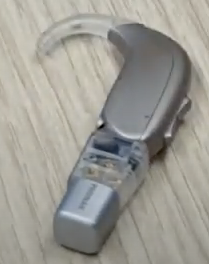
Roger X receiver
The Roger On, without the iN does get sold on the secondary market, for use with non-Phonak phones. Such sales do make sense, because with a plug-in (physical) receiver, the Roger X, one can augment non-Phonak HAs to use the Roger On. The receiver clips into a non-Phonak HA via a Digital Audio Input (DAI).
See the howto instruction video for doing this with an Oticon device. The extension does make the HA more noticeable.
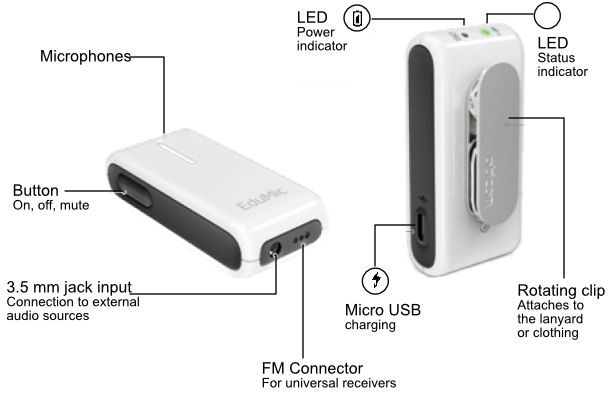
As per an HA forum discussion, an alternative option for using the Roger On with Oticon HAs seems to be the Oticon EduMic. It can clip onto the HA wearer, or be hidden in a pocket. When combined with a Roger X attached to the EduMic, the mic receives the Roger On microphone via radio link. The EduMic then forwards the sound to the unmodified Oticon HAs. This solution needs to be investigated further before purchase.
What then is that $750 device mentioned above? It’s a refurbished Roger On; no iN. Want an iN? You can get that refurbished for, say, $1400 on eBay. So, investigate carefully. I did buy a refurbished On iN on eBay for $1K. Still outrageous for what is a $10 circuit board with four mics.
The Web Purchasing Path
So, Costco, hearing clinic, or the Web? My experience is incomplete, in that I experienced fitting only in clinics, not at Costco. Spoiler alert: I went with ZipHearing.
Buying through a clinic tends to be significantly more expensive than buying from the Web. Example: one clinic quoted $8140 for a Phonak Lumity 90 (top tech tier). The Web provides them for $4598. More detail further down. Note that manufacturing cost for the typical HA is $50.
The clinics argue that their higher prices cover the care by a Dr. of Audiology, careful evaluation, fitting, and after care. In my experience their facts are straight. Treatment is courteous both in clinics and at Costco. To compare the two options, I took a hearing test both at Costco, and a local hearing clinic. The comparison:
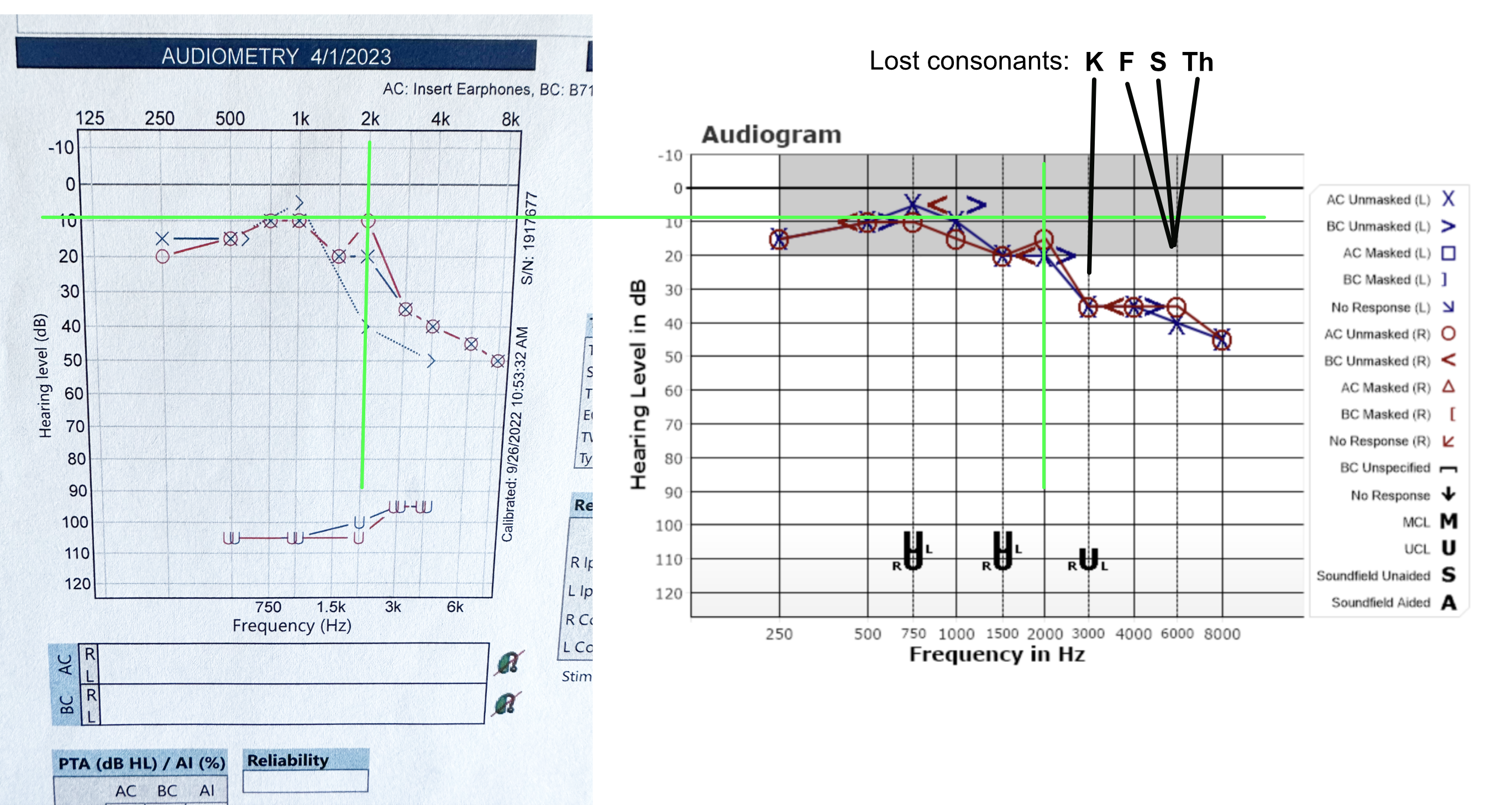
The sounds, K, F, S, and Th are lost with the hearing loss shown in this chart, as hearing levels at their frequencies are too low.
More on sound sources and lost speech sounds.
While I very much liked the clinic experience, I could not stomach the much higher pricing. I excluded Costco, because they did not carry the two brands I had set my sights on: Oticon and Phonak. Apparently the discontinuation of the Kirkland white label was due to technical problems, which gave me pause. Further, the quite negative result of a secret-shopper experiment on Costco made me uneasy, because I had seen many excellent videos by the reviewer. Another video by the same reviewer described how treatment can go wrong not just at Costco, but in clinics as well, when some of the needed tests are omitted.
One outfit, Yes Hearing, services you at home; no clinic. My understanding is that they come just once, carrying everything with them. The hearing test is done without sound booth, just with headphones. A brand is picked, and fitted on the spot. They offered my product of interest for $300 less than their competitor. But I wonder how they perform, for instance, the Real Ear Measurement on the road. They might! Or maybe they will skip it. I did not try to find out. Caveat emptor.
Buying the Hearing Aids
I ended up buying from Jeff at ZipHearing. He sells the Phonak Lumity 90 for $4,598.00, instead of the $8,140.00 clinic price. I was extremely uneasy, given the large difference. But the store’s reviews were positive. Remember the Real Ear Measurement (REM) that adjusts hearing aids to a person’s prescription? You don’t want to go without that, and reportedly, a Web shop that sells to you directly is suspect.
Instead, Jeff contracts with local hearing outfits. You visit them for a free hearing test. If you want to buy, the practitioner sends the order to Jeff, who then contacts you for your credit card. The device(s) are sent to the practitioner to whom you return for fitting, and then again after 30 days for follow-up. Jeff pays the practitioner for those services.
My contract clinic is located a few miles North of my home. Looking up the address got me queasy. The address is owned by Davinci Virtual Office. Hmm, will this be a virtual audiologist? Will my eventual hearing aids be virtual as well? Maybe they’ll be hosted in the cloud?
But what the hell, let’s check it out.

office building
There was in fact an audiologist guy, who told me that he has been in the business for 23 years, six of them in HA research with a company I recognized. He was an interesting man.
Short tangent: when you are a woman in contact with an expert, like a car mechanic, he may belittle you, try to pull one over on you. As a man, your life is in fact no easier. You need to prove that you know your shit. But that you are not out to prove that you know the shit under discussion better than he does. Only when you can navigate that ridge can you have a productive interaction.
With my audi (affectionate term used for an audiologist in HA forum posts) it took quite a while to climb that ridge. He was of the combative type. Paraphrasing(!):
“Don’t try to tell me that one hearing aid is better than another. I’ve been in this business longer than you, punk. The such-and-such you just mentioned is crap. Almost anything you might mention is crap.”
The approach to reaching the ridge for this type is not to insist, or question competencies, or try to provide proof of your position, but to be interested in what your opposite considers non-crap, and ask for help in understanding the crappiness of your favorite device.
Took a while in this case before I could convince my audi that I truly respected him, though I do know what a REM is and does. After reaching the ridge we had a great conversation. He insightfully compared the hearing aid market to the car business. And he did not trash other clinics. Always a good sign.
His borderline dismissive views of hearing aids proved quite helpful. He explained that HAs have made comprehensive progress in past years, but they are mostly equivalent, because they don’t address the actual problem. Which is the loss of little nerve fibers. But, he stressed, individual differences do matter, and can affect one’s perception of one HA’s quality over another.
In his view, if after 30 days you are not convinced that your HA makes a noticeable difference, admit defeat, and return them. The improvement should not be a matter of having to talk oneself into it. Just “wave the white flag,” and return them.
At the end we were roughly on the same power level, with him, by design, just slightly higher to keep him comfortable. Interestingly, at the initial clinic, the female practitioner offered the opposite experience. She couldn’t stop smiling, and she was relentlessly gently in her voice and demeanor. Determined not to offend. In her case I worked for quite some time to subtlety assure her that there was no need for a smile when discussing rechargeable batteries.
There was no sales push at all. My audiologist was happy to let me go without an order. But I took the plunge. The out the door price was exactly what Jeff had told me. A fax went to Jeff while we talked more. By the time I got home, there was a voice mail from Jeff. After revealing my credit card particulars over the phone, with a little bit of fear, I was assured that my HAs would be in hand inside 2-3 days. If my Roger On iN arrives in time, I can try it all out at my next noisy event. I’m very, very curious. Plus, the HAs will replace my Apple Ear Pods for podcasts and phone calls. Except that the Earpods insulate from external sound which, at least, open domed HAs do not.
Buying the Roger On iN
I could not face the Roger On iN pricing. Prices vary between $2,100, and $1,900. So I dared a route I’ve never taken. Ebay reburbished. The seller, repurpose_sound_accs, has good reviews. I was at first excited when I saw them selling at $750. I made an offer, but then understood that the price was for a Roger On, not a Roger On iN (see how alert you need to be?). My interactions with the seller around withdrawing the offer, and her response to my question about what refurbishing means raised my confidence. The price for iN was $1,400. They rejected an $800 offer, but accepted $1,000.
The first device I received was a dud in that I failed to transfer the licenses from the microphone into the HAs. Quite possibly the issue was a missing firmware upgrade.
However, the seller was excellent around fixing the issue. It was clear from my email exchanges with them that they cared about hearing impairment. They sent a replacement, which worked perfectly.
Resources
Which Sounds You are losing

Sites on the Web
I frequently consulted the HearingTracker forum. These are people that use hearing aids, discuss their experiences freely, and answer questions without trolling.
The short Dr. Cliff, AuD videos are fantastic resources. He runs a clinic in Phoenix, and publishes hearing aid related videos most weeks. The current ~150 videos cover a wide range, and many answered questions for me. He has strong opinions, and you need to get past his request to hit the thumbs-up button at the start of each video. But the content, I found, was great.
An article about speech intelligibility in general.
Test Driving it All
I partition my impressions into a section for the HAs, and another for the Roger On iN microphone accessory.
Summary: I purchased a pair of Phonak Lumity 90 hearing aids on the Web from ZipHearing. I also bought a Phonak Roger On iN refurbished from eBay’s repurpose_sound_accs.
Both purchasing experiences were excellent. I am very happy with both products.
Phonak Lumity 90 Hearing Aids
The HA purchasing experience went smoothly; couldn’t ask for better. The ZipHearing audiologist did a great job fitting the HAs. He took his time explaining everything. He called after one week to check in. There will be a follow-on appointment 30 days after the purchase.
I have been using the HAs for about three weeks, and love them. Unless something unexpected happens, I will keep them.
I hear many sounds around the house that I missed before. Including the clicking of my keyboard. It is likely that my brain will learn to block those out. I don’t mind them at all, though. I enjoy the recovery of audio acuity and awareness.

The microphones are sensitive enough to pick up sound across considerable distance. The photo shows a water fountain quite far away. The splashing of water is clearly audible in the HAs. I could have moved even further away.
A family gathering of 7 adults, and a continuously verbalizing 1.5 year-old yielded 100% understanding all around the table. Playing with the child on the floor about 15 feet away still had me follow the conversation around the table. One of the adults speaks softly, and mumbles. He sat at the other end of the table. Still, I caught his mutterings.
Nobody visually noticed the HAs. It was almost insulting, after spending so much money 🙂

An unexpected benefit is the wind noise suppression inside a motorcycle helmet. As with other advanced HAs, wind noise is recognized as undesirable and filtered. This effect increases riding comfort, and helps mitigate further hearing damage. I have not, however, run a proper A/B test for this effect.
While the HAs are great, the associated smartphone app, MyPhonak has the worst reviews on the Apple store among apps I ever installed. However, I cannot confirm the complaint that the app takes a long time to pair with the HAs. Pairing is nearly instantaneous.
The app’s primary functions are volume control, and forcing the HAs out of automatically adjusting their equalizer and filters, into a particular mode (table mic, manually pointed, presenter).
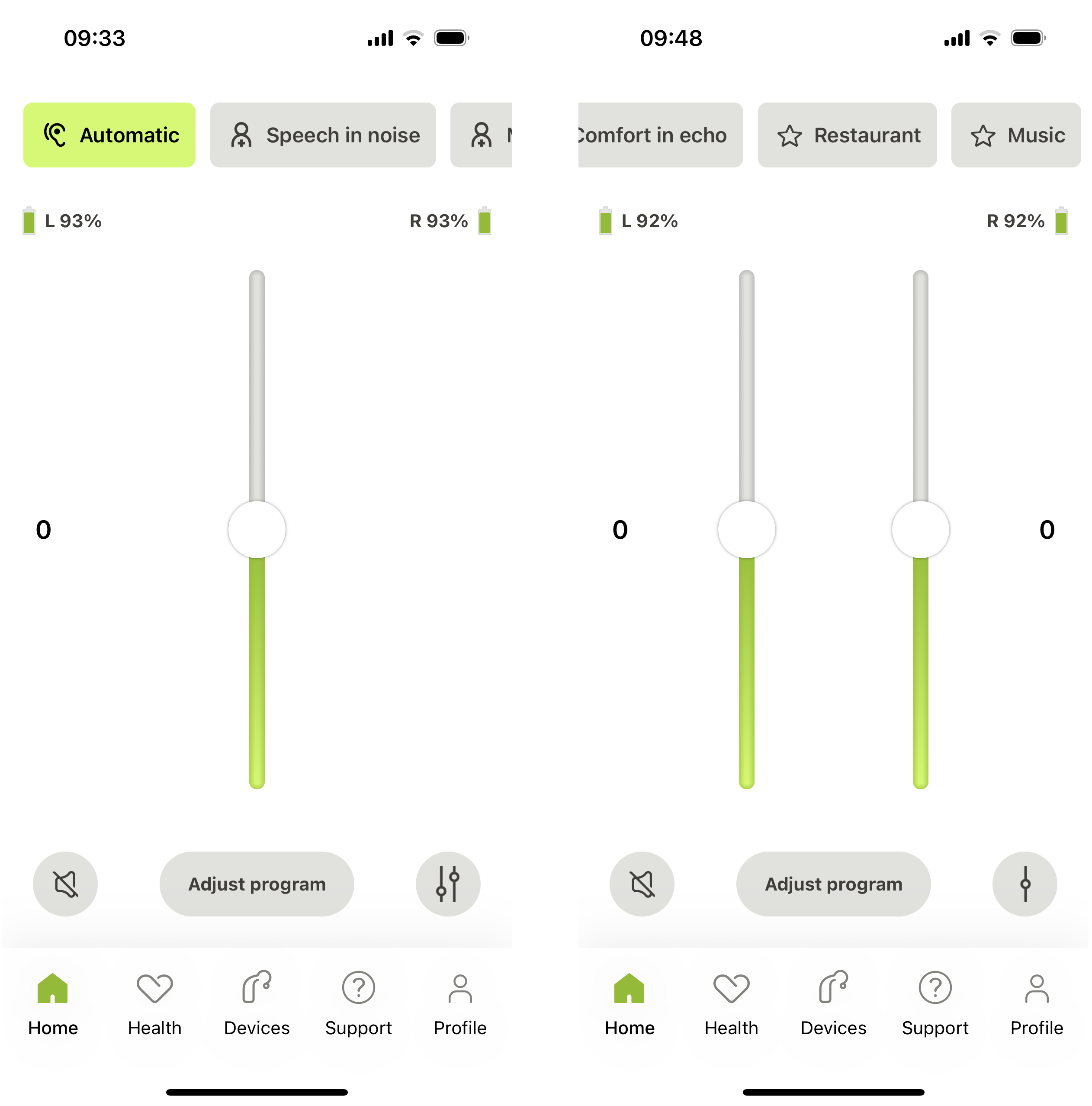
I have not found a need to leave automatic mode. The HAs seem to adjust to soundscape changes fine.
Beyond this bare minimum, Phonak’s software prowess is minimal at the very best. The app, for example, does not switch to an iPhone’s landscape mode on rotating the phone. There is also no Apple watch support. Interfacing to the watch is a perfect application for an HA. Every function of the app could be operated on the watch. Volume control in particular would be great.
Where software support misery truly starts is with firmware upgrades, or any other support and maintenance application: It’s Windows only.
What is proving a challenge is to remember that Covid masks are held in place with rubber bands. Taken the mask off, or sliding it down to hang around my neck had me flick the HAs out of my ears multiple times. Removing my motorcycle helmet holds the same danger. The devices comes with insurance for one replacement for each of the pair, with a deductible of about $350. But who wants that hassle.
The Bluetooth connectivity works great for me. The HAs can maintain two connections simultaneously. I have one dedicated to my smartphone, the other to my iPad. Phone calls route directly into my ear. All movies I watch in my iPad feed audio into the HAs as well. Occasionally I panic when I cannot reconstruct which device is generating sound, so that I can talk into the proper microphones. The HA microphones do function during phone calls. However my voice reportedly sounds muffled when they are the main pickup. So I speak into the smartphone instead.
Phonak Roger On iN Microphone
The purchasing experience via eBay has been excellent, as reported above.
I tested the device in the worst possible scenarios: a reverberant kitchen filled with conversing people, sitting around a picnic table outside, and a long table inside, with around 15 speakers seated around its perimeter.
The Roger microphone was great. I tested pointing the microphone at individuals in the kitchen, and could pick them out of the noise. The only time this failed was when very loud voices nearby dominated the soundscape.
For the table scenarios I placed the device just beyond my dining plate. This position sufficed to pick up everyone around the table, even with some speakers competing. The Roger attempts to find voices, and block out other sound. The effect is subtle enough not to be odd.
An unexpected benefit and curse was the (2.4GHz) connection between the microphone and my HAs. It’s obvious once you think about it!
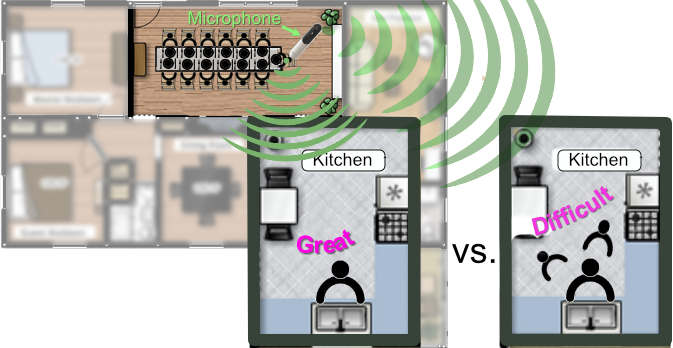
When I left the table to wash some dishes in the kitchen, I did not miss out on the discussions around the table. I had in the past always regretted this loss, particularly when a salvo of laughter did reach the kitchen. I’ll never miss a joke again.
However, when others then joined me in the kitchen, and attempted to talk to me, I could not make out their speech, because of the interference with the conversations around the table in the other room.
Overall: expensive and very useful, even for my “mild to moderate” hearing loss.
 Musings