I have entered a quite sparsely populated region of Northern British Columbia, along Route 37. This is one of only two roads to the Yukon Territory. Other than a car or motorcycle every ten minutes, there is no human activity; no settlement, no logging. As mentioned, that sparsity makes finding lodging tricky. I did find space in Dease Lake, at the cost of an eight hour riding day, with little time off-saddle. That worked just fine, though. My body is made for sitting; it‘s my superpower.

Gas was a bit of an issue. There was just one gas station that I skipped, (a) because I still had plenty of fuel, and (b), because they only had regular. But then I get into a situation:
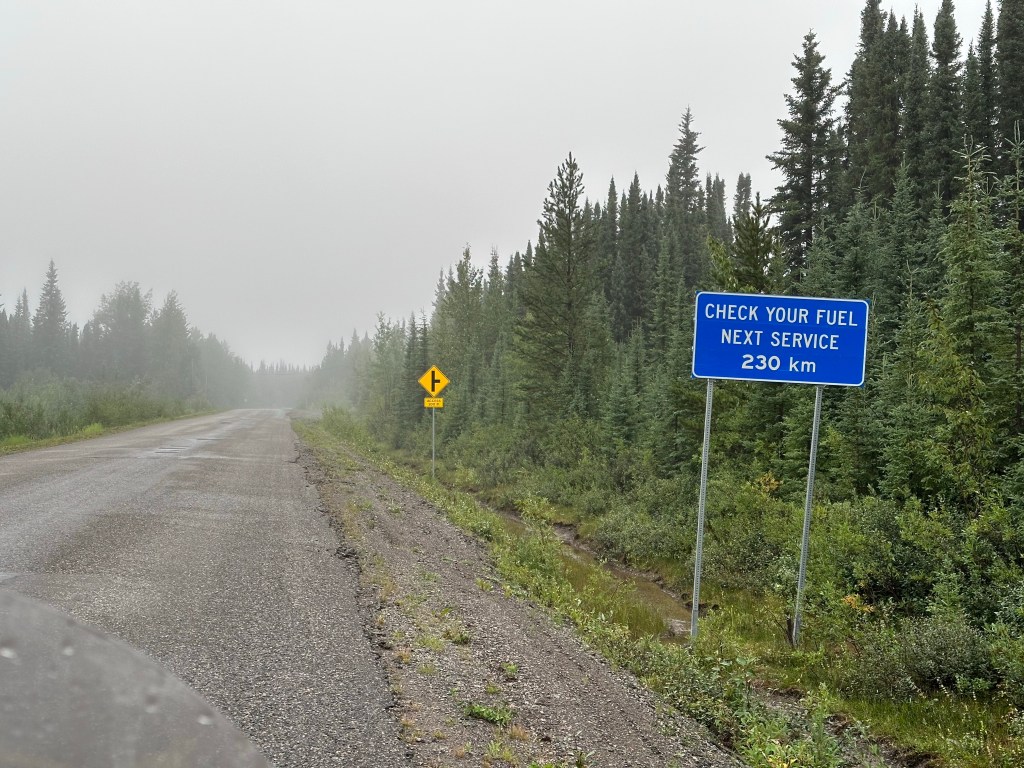

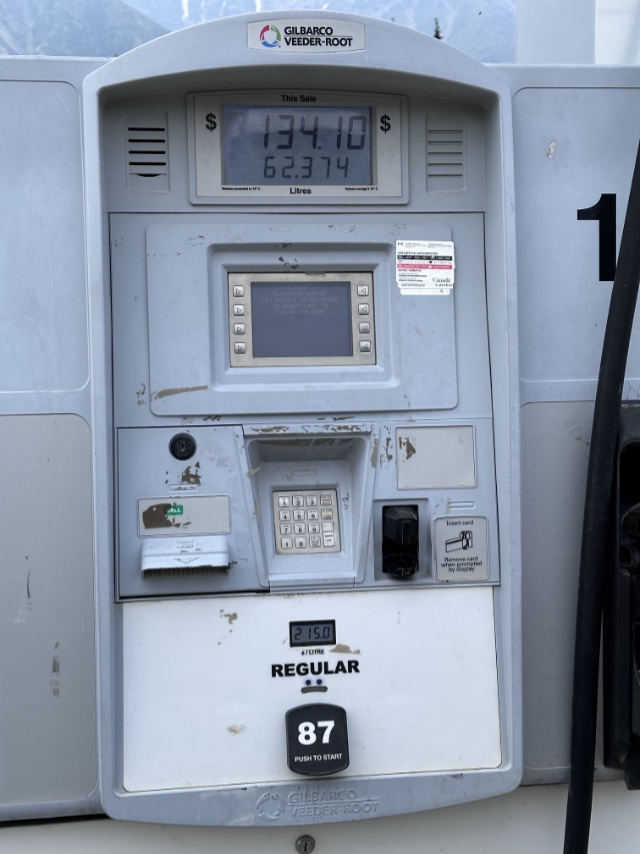
Some hundred kilometers on, and 80km from the next one, I no longer have a choice. Regular it has to be. I add a half tank, and make it to my final destination without any unusual noises, like knocking. I then top off with 91 octane. Hopefully the bike will forgive me. Along the way I took to disengaging the clutch on downhill stretches to conserve fuel.
Update: one day later we haven’t seen 91 octane at all on a ~500km stretch.
Dease Lake Northway Motel
The gas station, and motel are it for Dease Lake. I had hoped for a restaurant, which usually complements motels. None in town.
„There is a grocery store. You can get frozen dinners, and use the microwave oven in the common area. You are also welcome to use the grill outside.“
It‘s raining. And cooking is not what I had in mind. But hey, rolls, a ring of garlic sausage, OJ, bananas, yoghurt, salt pretzels, and coke will do. And it did.
Non-Woke in Northern BC
I expected wokeness to have penetrated the North, but the door cards suggest otherwise?
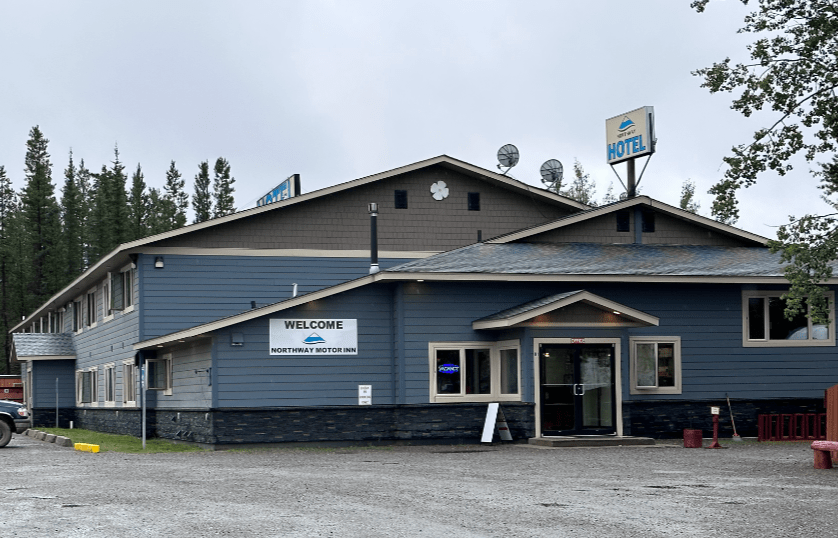

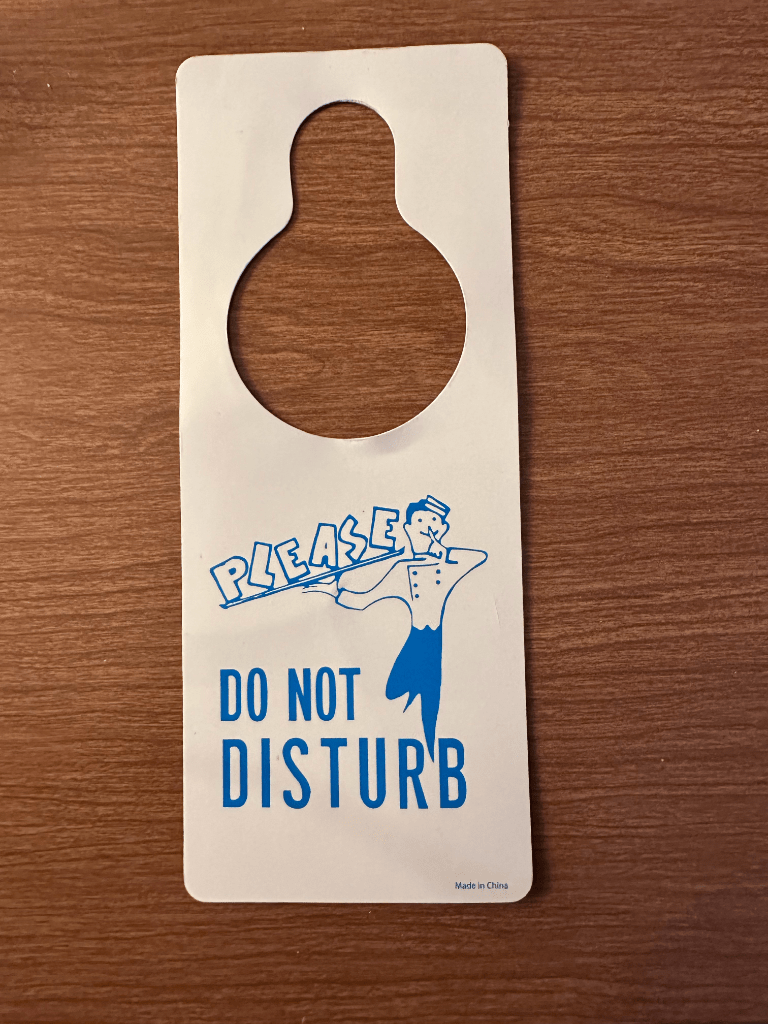
Well late this morning the „maids“ show their true colors. Most guest doors are open, the guests moved on to their next destination. This is a one-night motel for all but me. The rooms are being serviced by maids.
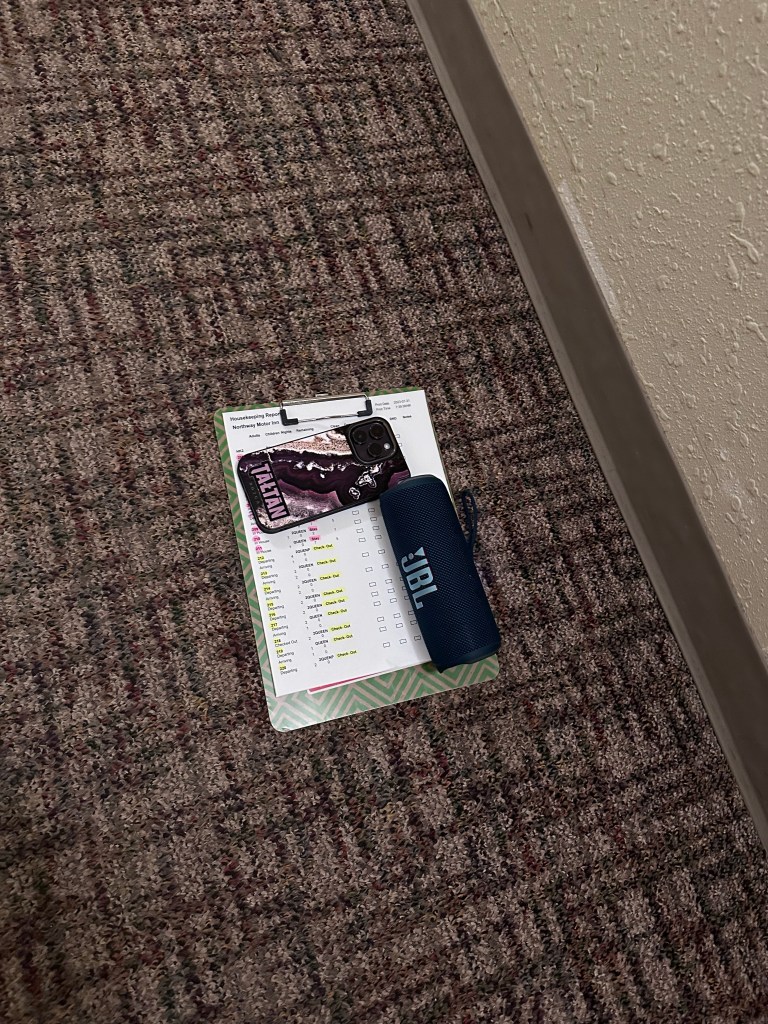
On the floor right in front of my room: the todo tablet, and a tiny, round speaker of ear shattering power that fills the entire, long corridor:
We’re not dealing with the maid from the door sign, no siree.
Self Disappointment
During the ride I re-discovered an important aspect of my personality. Here is how.
Roads here are almost always elevated by a couple of feet, presumably to have room for snow, when plowing, and for drainage.
Imagine the ditch in the image, but the side away from the road is a hill.
I see up ahead a pickup truck off the side of the road. I ride by at about 70mph, and see that even being a pickup truck, this vehicle will need to be pulled out of this ditch. No skidmarks, though, no smoke, no other vehicle. Abandoned to get a tow truck.
I ride on, but conscience starts nagging.
„What if this was an accident?“
„Nah, there would have been some indication.“
„Shouldn’t you turn around and check whether anyone is in the cab?“
„Well, I suppose I could. But I‘d just be peering into an empty cab.“
„How do you know?“
„Well, I don‘t. But there wasn‘t even a dent to be seen, implying a violent departure from the road.“
„What about the side of the truck nestled against to other side of the ditch, though?“
„There‘d be smoke from the radiator!“
„Are you sure?“
„It was a straight stretch of road, nobody would have missed a curve. All straight!“
„What if the driver had a heart attack. Or a stroke?“
„Hey, now you‘re stretching, aren‘t you?“
„Maybe you should turn around and check?“
„There‘ll be other cars behind me. They’ll check.“
„Oh, really? Did you?“
„Well, maybe not. But we know it will rain. The forecast threatened lightning near our destination today. We need to keep going.”
“Just a peek into the cab isn’t even close to the time it takes to fill your tank.”
By then I’m pretty far along. And turning around would mean that whole distance, and then the same again after checking.
I brood, but keep going.
A police and ambulance with their lights flashing race towards me, obviously looking for the pickup truck.
“Shit!”
“I told you!”
“I couldn’t have pulled the driver out of the cab at that tilt. And what would I have done about a stroke or heart attack anyway?”
“You could have comforted the person. Reassured them. Or, had they lost consciousness, maybe reported to the paramedics what the driver had said before passing out.”
I am not a Good Samaritan by reflex. I knew that, but now I know even better.
Fiber
A few miles on I am stopped by a flag man. I’m the only vehicle, and we get talking. I can see the crew a bit further down the road.
“What are you guys doing?”
“We are laying fiber, all the way from X to Y” [names places very distant from each other]
“How do you do that?
“We use something like a plow next to the road, and as we create the ditch, we lay conduit”
I am glad for the distraction from my dark thoughts about myself.
“So then your pull the cable though?”
“No, we push it through with pressure. Every once in a while we come up to the surface, this is one of those points.
But hey, what’s the accident back there where you come from?”
I feel the strongest need to confess to this flagman, so I honestly describe the situation, and:
“I should have stopped. I should have checked. I feel bad.”
“Nah,” he reassures me. “Police and ambulance are on their way. Say, what bike is this? I have a Harley. Heaviest bike I ever had.”
And so we wash self doubt downriver with engine talk.
En Pointe Powerline Posts
I notice that most of the over-land high voltage powerline posts here are held upright similarly to commercial radio antenna towers.
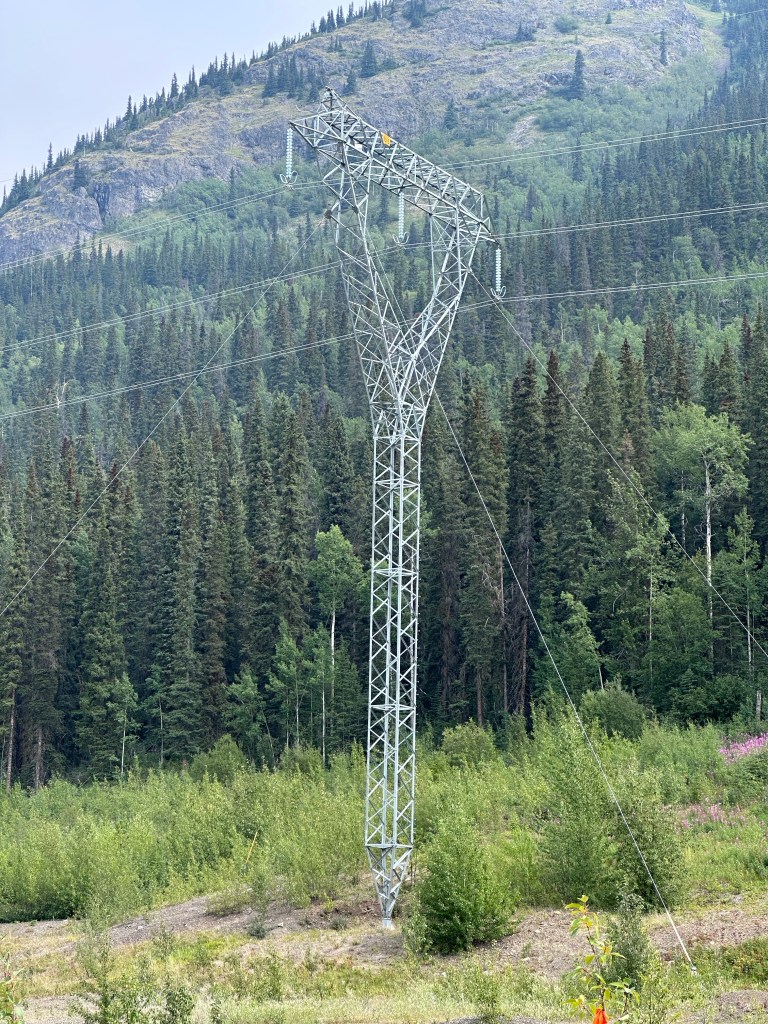

Some posts in between along the lines have four legs, like you see in the States. This one-legged balancing on a truly small point of ground always felt tenuous to me. But I guess if you get the guy-wires just right, it’s stable. Yet, I worry about those posts. Does anyone know the story? Are they done this way in the States as well?
Maybe, already so poised, at night, the Trepak rings out in the forest, they poles come alive, bow, and pirouette?
Or is this method simply cheaper, and faster to install?
RVs Amidst Scarcity
I don’t mind RVs. Even the ones the size of city busses, with an extra Jeep in tow. But here is the problem when you have gas stations spread out to thin margins of error.
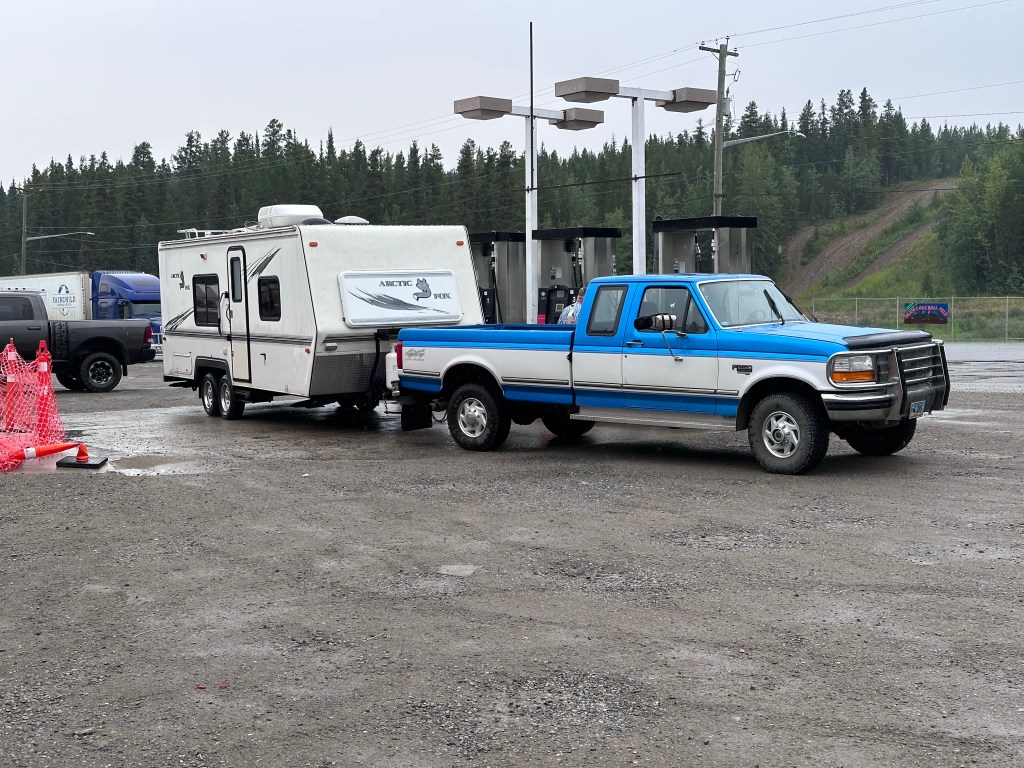
They all crowd the pumps, like elephants at a water hole. Obviously, each takes two slots, leaving everyone else waiting behind in the mud. Because we are not talking about cement floored Chevron stations.
Helicopters Mid-Forest
Food is naturally spread as sparsely as fuel. I find one place in the middle of nowhere. Why is this place here? Nothing else, no houses. Not even a road service yard that little city dots on the paper map all turn out to be.
Heliskiing. That’s what brought my waitress here. Amazingly, they do plow this lonely road daily. But in a storm, you are on your own. In the summer, it looks like the helicopters transport flame retardants.
I should know why they make the suspension lines this long. But I don’t. Clearly, they can’t be short enough such that the load hits the aircraft. But at this length, the payload swings huge distances. I bet there is a pendulum based explanation here. Let me know. I bet it’s obvious.
Prejudice Baking
Remember the post in which all but one gas station pump was broken, and one of the local residents commented to me:
“It belongs to the Indians, so it’s all falling apart.”
A bit of local prejudice there, I thought at the time.
A few days later, I stayed at a motel in which every one of three soda machines not only didn’t take credit cards, but dollar bills either? All were broken. That motel stood on a reservation.
“Hmm, I found myself thinking. Maybe that man was right.”
A voice inside instantly chastised me:
“Maybe tribes just don’t get bank credits for new gas pumps or soda machine updates! Get a grip, Andreas. You are a liberal.”
Now, this morning, at the motel I had a long conversation with one of the room service women. She is 56 years old, clearly of First Nation descent, and proud of that. She grew up in the Indian settlements near one of the places I touched, riding through some days ago.
“My grand mom, she didn’t like innovation. When they paved the road: ‘What a waste of money,’ she said. When clothes dryers came out, she refused. Summer and winter she hung the clothes on the line outside. ‘Nonsense, these new machines!’
“Then the family got a TV. The first thing she saw on the TV was wrestling. And she watched that till the end of her days.”
At some point the housekeeping woman describes the relationship with her son, who died some time ago.
“He was my eldest, and I was closer to him than to any of my other children. He could feel my pain from afar. He’d be in Edmonton, and I was crying over something. He’d show up: ‘Mom, I felt something was wrong with you. What’s happening? Come, lets go out for dinner.’
“My other children, they might be in the kitchen, and hear me crying in the next room; they wouldn’t come in. But my son, he was different. He felt my pain from afar.”
Later in the conversation, about how she likes interacting with all the people who come through:
“One Japanese gentleman, he is running from Anchorage to Vancouver. It’ll take him three years, he said. He runs six days, and then rests the seventh. ‘Oh, goodness, the Lord bless you, that’s amazing,’ I told him.
“On the morning when it was time for him to leave he said to me: ‘Oh, that was such a nice bed. I wish I could sleep there again tonight.’
‘But you do have a choice,’ I told him. ‘You had the choice to start running. You could choose to stay another night in that bed.’…
‘I know,’ he laughed, but he left and ran.”
We turn to bicyclists that cycle this route:
“Oh yes, they come through. They take their bicycles right up to their room. And I don’t blame them. There’s a reservation nearby. Those bicycles could well be gone in the morning.”
So, prejudice. Now what do I do?
Be Tested Till You Get It
Many kilometers on I am still thinking of my failure to help…when:
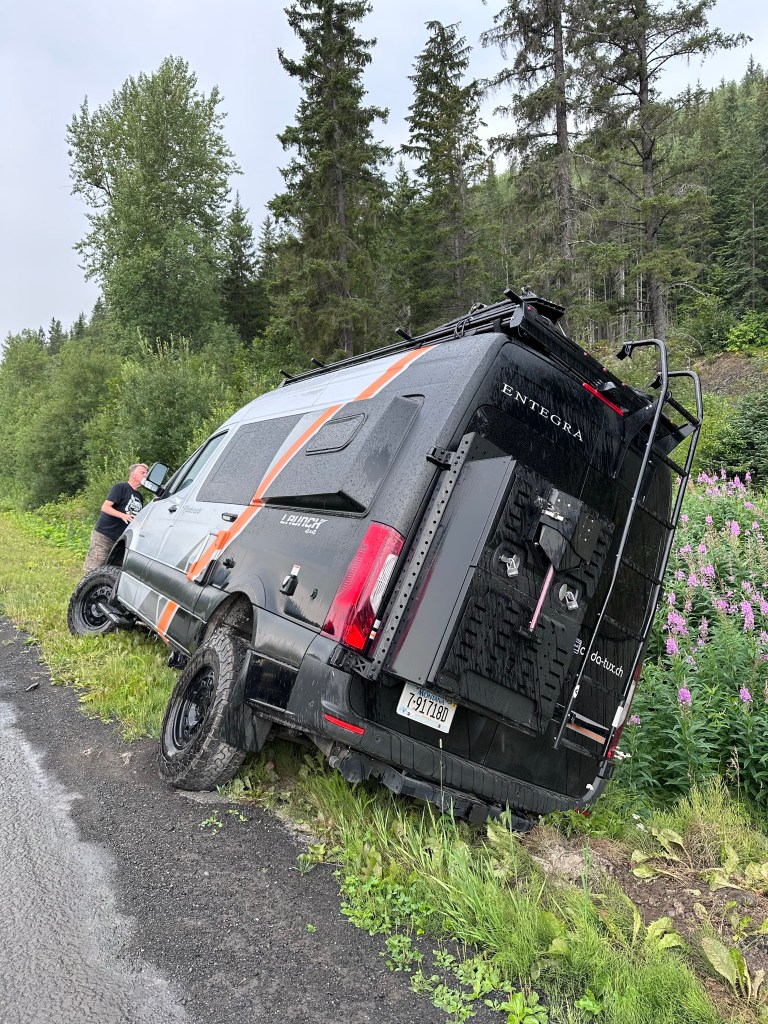
I instantly apply both brakes, and peer into the cab. As I do that, two trucks and a camper stop as well. My concern, expressed by stopping, make others care as well.
The cab is empty. I feel good. But I know: this changes nothing.
 Musings